
WTVN Radio • Columbus, Ohio • Sunday morning from 8 until 9
Who's in the corner?
Is this information useful? If so, consider
making a contribution, please.

|
|
WTVN Radio • Columbus, Ohio • Sunday morning from 8 until 9 |
|
| Home
• Previous
page Who's in the corner? |
Is this information useful? If so, consider |
|
| |
Sunday, May 30, 2004 |
Random thought:
|
 |
|
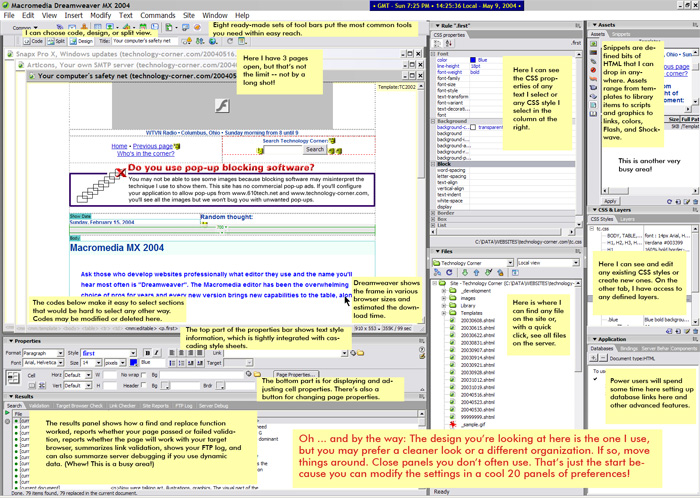
Macromedia Studio MX 2004Ask those who develop websites professionally what editor they use and the name you'll hear most often is "Dreamweaver". The Macromedia editor has been the overwhelming choice of pros for years and every new version brings new capabilities to the table, along with the occasional bug. The current version, MX 2004, is similar to the previous MX version with some extra features and an activation requirement. A single copy of Dreamweaver can be activated on two computers, but both must be the same platform. Earlier versions allowed me to use Dreamweaver on a Windows PC and on a Mac, which provided more insights into how the applications functioned on both platforms. The earlier system also allowed a single user to install Dreamweaver on any number of PCs and Macs. While I understand the need for Macromedia to establish an activation procedure, I wish that an application could be installed and activated on any number of machines (or at least 3 machines, either PC, Mac, or any combination) as long as only one version is active concurrently. That would allow people like me who use Dreamweaver on a primary PC to develop Technology Corner and on a notebook for teaching Dreamweaver techniques to also install the program on a Mac -- for evaluation or teaching. The MX 2004 version also has some odd bugs that Macromedia is still trying to eliminate. One that I see from time to time is an application crash whenever I try to accomplish a "find and replace" operation. Once the application has crashed on a find-and-replace it will (almost) always crash on subsequent F&R operations until the user follows instructions from Macromedia to correct some corrupted data. I also occasionally see a problem when trying to add a link to a website: Dreamweaver may erroneously tell me that the code I'm trying to apply the link to is in an uneditable section. It isn't, of course, but I must apply the link manually in code view or by using one of the application's alternate link functions. These problems are mere annoyances. One hopes that Macromedia will soon fix them but the application is so robust despite the shortcomings I have no interest in trying some less capable application even if it arrives with no bugs. Here is an annotated screen capture of this page under development. Each of the several "clickable" areas of the image below will display an enlarged copy of part of the screen.
But that's not all. Macromedia Studio MX 2004 covers all the bases for website designers by including Flash (and Flash Professional), Fireworks, and FreeHand. Flash is the application that creates animations, but can also be used for much more. Flash-powered forms and menus can add a distinctive look to a website, but Flash is also a good choice for static images such as maps. Because the images are vector drawings instead of bitmaps, the user can enlarge them to see detail. The professional version adds more powerful scripting capabilities. I find Fireworks a bit cumbersome to use and missing some of the high-end graphics applications features, but it has the best rendering engine for website graphics. No other application even comes close. One of my favorite Fireworks features is the application's memory. It saves information with the original file so that it knows what format you used when you previously output the website version of the graphic. When you have to update the file later, Fireworks remembers what file format you used, what size the final image was, what the color depth and transparency settings were (for PNG and GIF), what the compression was (for JPG), and what the destination directory was. FreeHand is Macromedia's high-end graphics application and it's the one application in the box that hasn't been upgraded to "2004" status. All of the other applications changed from "MX" to "MX 2004". FreeHand is still "FreeHand MX". It's still a powerful graphics application, albeit one I don't use frequently.
Bring order to stacks of DVDs and CDsIf you've collected a bunch of CDs and DVDs you've probably discovered that they're larger than they seem. They eat up shelf space and desk space. They clutter the top of the TV. They grow in little piles on the floor. If your house is like mine, the DVD you want to watch is on the bottom of the stack and getting to it threatens an expensive avalanche. Sharper Image has clever solutions to both problems -- clutter and access. You can store 80 DVDs in a little more than 1 square foot of floor space and still be able to get to any one of them in just a few seconds. Or you can store 100 CDs in just 1 square foot of floor space and have any one of them in hand in seconds.
Both units are about 4 feet tall. The light at the top (it's actually a couple of light-emitting diodes) turns on automatically when you flip the switch that rotates the discs and turns off automatically about 20 seconds after rotation stops. If you put the tower near an outlet, you can plug in the power supply (provided with the units); if not, you can run the towers on batteries (not provided). Besides eliminating the clutter and organizing your CDs and DVDs, the towers also just look cool sitting there.
For more information, see the Sharper Image website. Six months after "Can Spam" -- now what?Six months after the "Can Spam" act went into effect, no spammer has been charged, but the FBI claims to be making progress. The FBI says it has identified more than 100 significant spammers and hopes to charge 50 of them this year. The FBI's Jana Monroe testified recently before the Senate Commerce Committee. In questioning Monroe, Arizona senator John McCain noted that spam now accounts for "anywhere from 64% to 83% of all e-mail traffic on the Internet." The Can Spam act doesn't make spam illegal, but it does require that spammers honor unsubscribe requests. It does make illegal the use of computers that have been infected by applications that turn then into spam "zombies". Speaking of spam, Scott Richter and Julian Haight will meet in June at the E-mail Technology Conference in San Francisco to debate spam. Richter is the operate of "OptInRealBig.com", a company that floods the Internet with millions of spams every day. Opinion (mine): "OptInRealBig" is a lie. I have never "opted in" to any of Richter's "services" and yet I receive dozens of messages every day from his sewer. These messages come to addresses that I have used to register domain names and the addresses are ones that I would never (ever) use for anything else. I have not provided these addresses to anyone Richter is associated with, yet I received a flood of trash from him every day. Richter whines that Haight's blacklisting service kills messages from his "service". According to SpamCop's Haight, "Spammers say they are protected by the right to free speech, but people also have the right to be free of speech." What Haight doesn't mention is that "commercial speech" has never been "free". Commercial speech is regulated by the Federal Trade Commission and other agencies. Richter is fighting a $20 million lawsuit brought against him by New York Attorney General Eliot Spitzer last December. Spitzer may have political ambitions beyond New York State, but that's OK if he manages to clean up the sewer that is e-mail. Spitzer's suit claims that Richter and OptInRealBig.com send more than 250 million junk e-mails a day. Nerdly NewsMore annoying that spam? Worse than viruses?Does your computer have spyware on it? Maybe. If you see a lot of pop-up ads that you don't want, you might have spyware installed. And if it's there, you probably installed it. Dell says about 12% of all support calls deal with spyware. Microsoft claims that half of all requests for help with computer crashes involve spyware. And the problem is probably larger than it seems because many victims think their problems are simply the result of Windows malfunctions. The National Cyber Security Alliance says 90% of personal computers could have spyware installed. That seems high to me, but EarthLink tested 1,000,000 computers and found more than 29,000,000 spyware applications! If you have installed Kazaa, you almost certainly have spyware running on your computer -- applications that place advertisements on your desktop or change your browser's search function to one owned by a company that has paid Kazaa to sabotage your computer. There's also an application that can make your computer available to others without your knowledge or your permission. Kazaa is at least clear about its intent. Everything is explained in the licensing agreement users must approve, but who reads those? Not all spyware installers are as forthcoming as Kazaa. If you haven't installed every Windows security update and you accidentally go to a hostile website, you'll have spyware installed on your computer. Nobody will ask your permission. Nobody will explain what's being installed. It'll just be there. Even if you uninstall the malware, it might come back. An application can re-install the crud -- again, without your knowledge or permission. There's no real solution other than to have anti-spyware applications installed, making sure you have all Windows updates installed, and being extremely careful about software you install and websites you visit. And that means that if somebody offers you a "free" application, be suspicious. There is no free lunch. One spammer, cannedThe Can Spam act had nothing to do with it, but one bozo is going to prison for sending 850 million spams using accounts he opened with stolen identities will be spending at least the next 3 years in a New York state prison. The sentence was 7 years. That's the second bit of bad news for Howard Carmack. Earlier Earthlink won a $16 million civil suit against the guy. Carmack, who claims there were no victims, seems to think he's getting a raw deal. He was convicted of forgery, identity theft and falsifying business records for opening more than 300 e-mail accounts under names that weren't his. Among the "non-victims" were men from Ohio, New York, and Washington who ordered some of the "products" Carmack was selling. Let us know what you think about this program! Write to: |
||||||||||||
|
|
Privacy Guarantee:I HATE SPAM and will not sell, rent, loan, auction, trade, or do anything else with your e-mail address. Period.
|
This is the only ad you'll ever see on this site. It's for my website host, BlueHost in Orem, Utah. Over the past several years, they have proven to be honest, reliable, and progressive. If you need to host a website, please click the banner below to see what BlueHost has to offer. As if you didn't already get enough weather on the radio! Annoying legal disclaimer
[an error occurred while processing this directive] |
||

 Next time you're in a Sharper Image store (there are 2 in Columbus and 1 in Cincinnati) take a look at the "DVD Power Tower 80 Motorized Organizer" and the "Power Tower Motorized 100-CD Rack". The DVD unit sells for $170 and the CD unit for $150.
 Both units have lights at the top and a switch that rotates the cases forward or backward. As you fan through the cases, you can see not only the spines but also the face of the case. This is helpful because the spines on DVD cases are hard to read and the spines on CD cases are impossible to read.