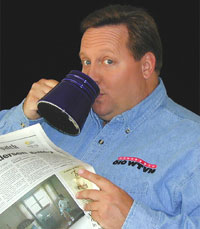
WTVN Radio • Columbus, Ohio • Sunday morning from 8 until 9
Who's in the corner?
Is this information useful? If so, consider
making a contribution, please.

|
|
WTVN Radio • Columbus, Ohio • Sunday morning from 8 until 9 |
|
| Home
• Previous
page Who's in the corner? |
Is this information useful? If so, consider |
|
| |
Sunday, April 18, 2004 |
Random thought:
|
 |
|
ACD See 6If you have a digital camera, you need a way to sort, find, and display the images. A program such as ACD See (from ACD Systems) does all of this and much more. Version 6 of ACD See is an aggressive update to version 5 and one that offers a variety of useful new features, but not without cost -- both in money and performance. If you don't own a previous version of ACD See, you'll pay $50 for the new version. Upgrades are just $30 from version 5. The other part of the cost is noticeably slower operation for most functions. Still, the enhanced capabilities might make the performance hit a worthwhile tradeoff. What's newThe performance problem is one that ACD programmers are aware of and a free update (to 6.03) that's now available provides faster start up and quicker browsing and viewing. The database function is also faster and thumbnail browsing and scrolling have been improved. The update adds support for Canon's raw image format, AOL's ART format, better memory management, and better support for EXIF information from your digital camera. So my objection to version 6's slower performance is hereby raised. Version 6 adds a host of features that will be welcomed by those of us who are digital photography fans:
For more information, visit the ACD See 6 page at the ACD Systems website. You can download a free trial version of the software and try it before you buy. Are CDs big or little?Someday all of our music files will probably be stored in computers and backed up to DVDs because CDs are just so big! As someone who still owns his fair share of large, bulky, fragile vinyl recordings, I'm taken aback by my claim that CDs are big. They're a small fraction of the size of an LP record and even the standard audio CD can hold more than a record. Convert the audio files to MP3, AAC, or Ogg-Vorbis and -- even if you use a high sampling rate -- you can put 100 or more tunes on a CD. Back the sampling off a bit, and you may get 1000 on a CD. So are they big or little? In this regard, CDs are a lot like vinyl records. Individually, an album seems to weigh next to nothing. But try moving across town with 500 of the things and you'll realize just how heavy they are. The individual CD in a jewel case takes up very little room, but if you have 200 of them you'll need some sort of storage rack for them. Or you could lay out the big bucks and get one of those 200-CD changers. How big are those bucks?Maybe a little historical perspective would be helpful here. I waited a long, long time to buy my first CD player. I wasn't an "early adopter" of this technology because the price seemed too high. I think the first player cost something like $200 or $250 and it held a single disk. As I write, a JVC 200-CD changer (model XL-MC2000) is sitting across the room from me. This changer has a list price of $200 (a quick on-line price check shows that discount stores sell these units for $160 to $180). You've heard similar stories from me about other high-tech items. The first CD players in computers were $600 items. Today, you can buy a simple CD player for under $30. Early laser printers cost $3500 and produced nothing but typewriter type; today you can find home laser printers for less than $500. Disk drives in the original IBM PCs added about $1000 to the price (for 10MB); today you can add a Seagate Barracuda 80GB, 7200 rpm, EIDE Ultra ATA/100 internal hard drive for about $85. This is just the way technology works. So now you can find a basic set-top DVD player for $50 and a changer that probably once would have sold for more than $1000 is now under $200. Is it worth the upgrade?Why a high-capacity changer is cool: It holds a lot of CDs so I don't have to find the CD I want in a rack (other side of the room), put the jewel case in a location that I will immediately forget, unload what's in the player, fruitlessly search for its jewel case (and finally decide to use the current CD's case for the old CD, which causes untold confusion), insert the new CD, and play it. Every hour or so, I don't have to repeat this process. That's why it's cool. And it looks cool, with a striking red light that shines behind the automatic "garage door". You may be a little bit ahead of me here. "What happens," you may be thinking, " to the jewel cases that no longer hold the 200 CDs that are in the JVC changer? And how do I remember that Dr Billy Taylor is in slot 133 and The Charlie Daniels Band is in slot 22, or that Carole King's "Really Rosie" is in 147 while a Barenaked Ladies CD is in 21? And," you go on, beginning to sound a little shrill, "how does this save me any space or reduce by confusion!?" Let me tell you: JVC has an elegantly simple solution to these problems. It's a book that's about the size of a photographer's proof album and it holds the booklets from 200 CDs. You can dump the jewel cases (saves space) and flip through the book to find the CD you want (saves confusion). The booklet contains a front page on which you can list each CD and there's even a sheet of numbered sticker (1 through 200) that you can stick on the booklets so you don't have to count pages and multiply by 4 to figure out which CD is in which slot. Maybe other manufacturers of changers do this, too. If not, they should. "Mid range" specificationsThe specifications are as expected for mid-range CD players. You won't find the ability to play the new HDCDs in this price range (HDCD use 20 bits instead of 16 bits to produce a richer, fuller sound. While HDCDs can be played on regular CD players, you need a CD player with HCD playback to hear the improved sound. But unless your other sound components -- and your ears -- are absolutely pristine, you may not hear any difference.) For you, this may be important. For me, it's not. But even mid-range players now come with an optical digital audio output that you can use if your amplifier has an optical input. It's impressive that this former high-end feature is now present on just about every CD player made. The XL-MC2000 is significantly larger than players that hold fewer discs (they have to go somewhere!) but JVC has maintained the standard audio component width (a little over 17"). Before buying, though, make sure that you have enough height clearance to fit the player (nearly 8") and depth (a whopping 19"). This leads me to wonder (as Charles Kuralt once did) when a number begins to whop. (I think it was Kuralt who wondered that, but I may be misremembering.) The player has a JVC high precision 3-beam laser pickup and uses 1-bit digital-to-analog conversion with an an 8-times oversampling digital filter. What this means in plain English: It sounds good. Mix it upAnd you can choose to listen to a disc at a time, all 200 discs, 32 discs or tracks that you program, random selections on a CD, or random selections on all CDs (in which case it's possible for Really Rosie to follow Dr Billy Williams and then be followed by the Barenaked Ladies and the Charlie Daniels Band. No sane radio station music director would ever allow a disc jockey to play a mix like this! Too eclectic. The change, of course, comes with a remote control (the only thing that doesn't come with a remote control these days is a cat and that's only because they cannot be controlled), a 1-year warranty, all the cables you need (unless you want to use optical digital), batteries for the remote, and a pamphlet that describes how the unit works. This is useful if you've been sleeping in a cave for the past 15 years. Actually, you should at least read through the instructions, where you'll find that you will break the changer if you try to turn the disc holder by hand. (The fact that it won't easily move should give you a clue, but some people use the "big hammer" approach to everything they meet.) You'll also learn that it's a good idea to take your hand out of the changer before you close the door. Unexpected benefit: When I had a 25-CD changer, I tended to listen to the same 25 CDs because it was too much trouble to put away 25 CDs and install 25 other CDs. With 200 CDs at my call, I'm listening to a lot of music that I didn't.
Nerdly NewsViruses and worms everywhereRobert Vamosi, writing for CNET News.com said "Throughout this latest swarm of Netsky and Bagle computer viruses, I've been trying to dream up a way we can all work together to reduce the number of viruses and worms spread on the Internet. It's not easy. Most of our current computer security strategy is based on after-the-fact mitigation, and we don't focus enough resources on prevention. Sure, good networks are built on trust, but no matter how many firewalls and antivirus scanners you install, it takes only one Typhoid Mary computer to infect a whole network." The article, available here, examines the current problem and recommends some ways that average users can help avoid the bad stuff that's out there. Lots of Windows updatesIf you haven't been to the Windows Update site this week and you don't have Windows Update turned on, you need to visit http://windowsupdate.microsoft.com/ now. Several patches were released this week that Microsoft says are updates for newly discovered vulnerabilities in Microsoft Windows. Source: http://www.microsoft.com/technet/security/bulletin/winapr04.asp Here's the lowdown:MS04-011 - Security Update for Microsoft Windows (835732) - CRITICAL
MS04-012 - Cumulative Update for Microsoft RPC/DCOM (828741) - CRITICAL
MS04-013 - Cumulative Security Update for Outlook Express (837009) - CRITICAL
MS04-014 - Vulnerability in the Microsoft Jet Database Engine Could Allow Code Execution (837001) - IMPORTANT
Additional warnings and notes
Let us know what you think about this program! Write to: |
||||||||||||
|
|
Privacy Guarantee:I HATE SPAM and will not sell, rent, loan, auction, trade, or do anything else with your e-mail address. Period.
|
This is the only ad you'll ever see on this site. It's for my website host, BlueHost in Orem, Utah. Over the past several years, they have proven to be honest, reliable, and progressive. If you need to host a website, please click the banner below to see what BlueHost has to offer. As if you didn't already get enough weather on the radio! Annoying legal disclaimer
[an error occurred while processing this directive] |
||